Lecture 16
Data-Level Parallelism
Lecture
Outline
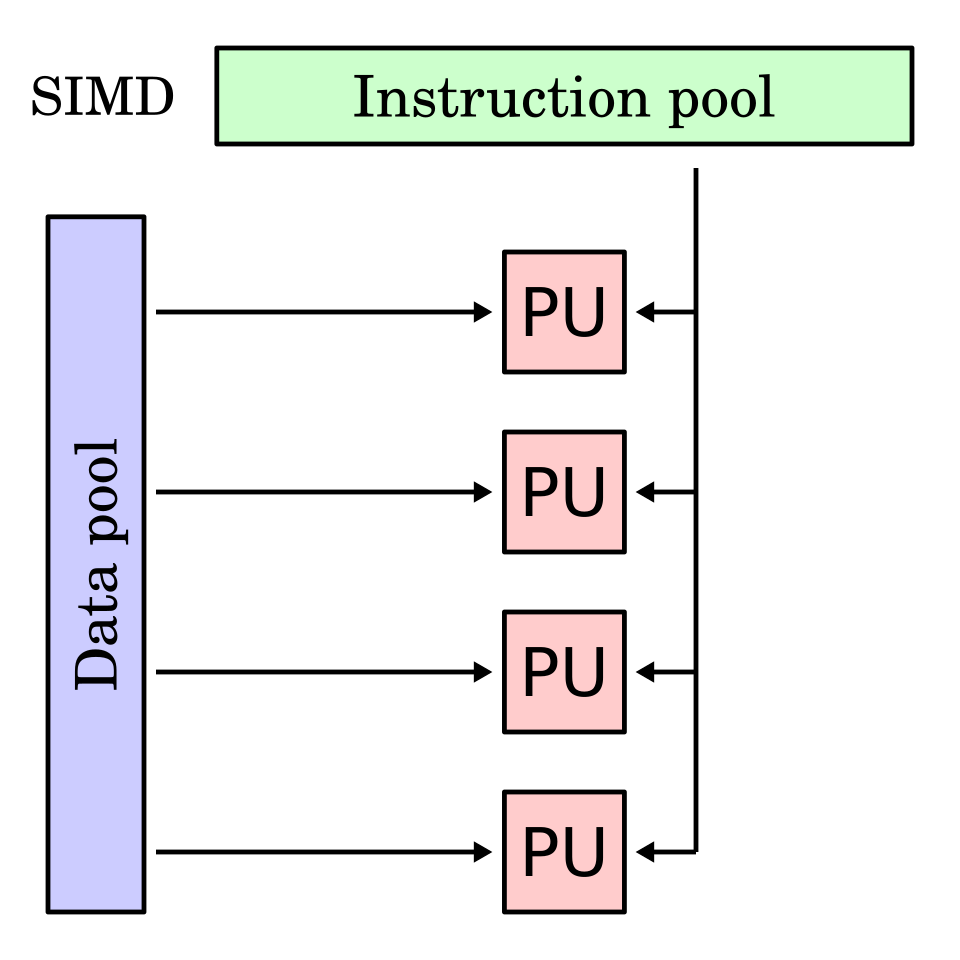
- SIMD Instructions
- Vector Instructions
- GPU
Examples
AVX (Advanced Vector Extensions for x86-64)
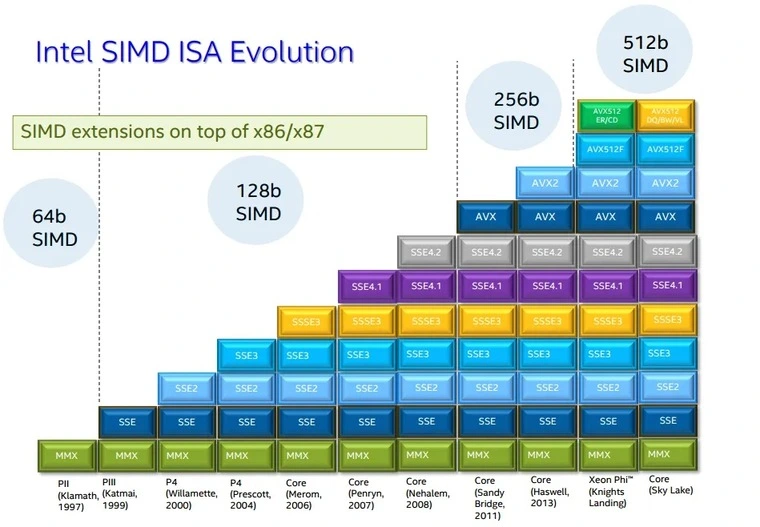
Optimizing DGEMM (Double-precision GEneral Matrix Multiply) using SIMD instructions.
See example matrix.c. Compile and run it with different versions of DGEMM:
gcc -o matrix matrix.c -march=native
./matrix
Check what AVX extensions are supported:
lscpu | grep avx
Unoptimized version:
void dgemm(int n, double* A, double* B, double* C) {
    for (int i = 0; i < n; ++i) {
        for (int j = 0; j < n; ++j) {
            double cij = C[i+j*n]; /* cij = C[i][j] */
            for (int k = 0; k < n; k++)
                cij += A[i+k*n] * B[k+j*n]; /* cij += A[i][k]*B[k][j] */
            C[i+j*n] = cij; /* C[i][j] = cij */
        }
    }
}
AVX2 version (4 doubles at once):
// #include <x86intrin.h>

void dgemm_avx2(int n, double* A, double* B, double* C) {
    for (int i = 0; i < n; i += 4) {
        for (int j = 0; j < n; j++) {
            __m256d c0 = _mm256_load_pd(C+i+j*n); /* c0 = C[i][j] */
            for (int k = 0; k < n; k++)
                /* c0 += A[i][k]*B[k][j] */
                c0 = _mm256_add_pd(c0, _mm256_mul_pd(
                            _mm256_load_pd(A+i+k*n),
                            _mm256_broadcast_sd(B+k+j*n)
                        ));
            _mm256_store_pd(C+i+j*n, c0); /* C[i][j] = c0 */
        }
    }
}
AVX512 version (8 doubles at once) - supported only in AMD and some Intel Xeon processors:
// #include <x86intrin.h>

void dgemm_avx512(int n, double* A, double* B, double* C) {
    for (int i = 0; i < n; i += 8) {
        for (int j = 0; j < n; j++) {
            __m512d c0 = _mm512_load_pd(C+i+j*n); /* c0 = C[i][j] */
            for (int k = 0; k < n; k++)
                /* c0 += A[i][k]*B[k][j] */
                c0 = _mm512_add_pd(c0, _mm512_mul_pd(
                            _mm512_load_pd(A+i+k*n),
                            _mm512_broadcastsd_pd(_mm_load_sd(B+k+j*n))
                        ));
            _mm512_store_pd(C+i+j*n, c0); /* C[i][j] = c0 */
        }
    }
}
Workshop
Outline
- Using RISC-V 64-bit instructions to simulate vector operations
Examples
NOTE:
The ld and sd instructions are 64-bit load and store correspondingly.
They are available in the 64-bit version of RISC-V and 64-bit mode of RARS.
To enable 64-bit mode in RARS, tick the checkbox in the Setting | 64-bit menu item.
This will make all general-purpose registers 64-bit wide.
The ld and sd instructions work in the same way as lw and sw,
the only difference is the data size that becomes 64 bits (or 8 bytes).
See the “Chapter 7. RV64I Base Integer Instruction Set” in the RISC-V instruction set manual for details.
Tasks
-
Write a program that inputs an integer value
N, inputs 2 matrices of size 4 *N, adds the two matrices, and prints the resulting matrix. Each element of a matrix is a byte value. Elements of the matrices are added by4, to simulate vector operations. Hint: Use thelwandswinstructions to load and store 4 elements at once. -
Implement function DAXPY (double-precision
Y = a × X + Y) using Intel AVX2 instristics (256-bit operations). Check the correctness by comparing with a simple implementation (without SIMD).
TODO: More tasks
References
- Flynn’s taxonomy (Wikipedia).
- AVX instructions in x86. Sections 3.7 and 3.8 in [CODR].
- SISD, MIMD, SIMD, SPMD, and Vector. Section 6.3 in [CODR].
- Data-Level Parallelism in Vector, SIMD, and GPU Architectures. Chapter 4 in [CAQA].
- Algorithmica / HPC. SIMD Parallelism.
- Christopher Woods. Efficient Vectorisation with C++.
- Chapter 31. “V” Standard Extension for Vector Operations in RISC-V instruction set manual.
- RISC-V Vector Intrinsic Document.
- Programming with RISC-V Vector Instructions.
- Intrinsic function (Wikipedia).
- Mirror of Intel® Intrinsics Guide.
- Intel’s Advanced Vector Extensions (Wikipedia).